
Viviana Zargón
b. 1958 in Buenos Aires, Argentina
Viviana Zargón
b. 1958 in Buenos Aires, Argentina



VERÓNICA DI TORO
WORK
GRIDES
Di Toro creates large series, exploring the plastic possibilities of form and color, through a powerful abstraction that is unquestionably limited to two-dimensionality. Rigorously guided by geometry, her painting is at once vibrant, systemic and purist. The lines that intersect, break or dispose in parallel generating planes and creating modules that divide the surface. With these few elements, Di Toro elaborates a precise logic that she will be able to recombine in new paintings, with only introducing minimal alterations. In this way she gives rise to a system in which each element is intimately linked with the others: each color, each shape, each distribution in the plane, pre-announce to others. Analytical and highly encoded, Di Toro's abstract geometry is presented as the corollary of systemic thinking, but never predictable.
Maria Eugenia Spinelli


GRIDES
Di Toro creates large series, exploring the plastic possibilities of form and color, through a powerful abstraction that is unquestionably limited to two-dimensionality. Rigorously guided by geometry, her painting is at once vibrant, systemic and purist. The lines that intersect, break or dispose in parallel generating planes and creating modules that divide the surface. With these few elements, Di Toro elaborates a precise logic that she will be able to recombine in new paintings, with only introducing minimal alterations. In this way she gives rise to a system in which each element is intimately linked with the others: each color, each shape, each distribution in the plane, pre-announce to others. Analytical and highly encoded, Di Toro's abstract geometry is presented as the corollary of systemic thinking, but never predictable.
Maria Eugenia Spinelli


GRIDES
Di Toro creates large series, exploring the plastic possibilities of form and color, through a powerful abstraction that is unquestionably limited to two-dimensionality. Rigorously guided by geometry, her painting is at once vibrant, systemic and purist. The lines that intersect, break or dispose in parallel generating planes and creating modules that divide the surface. With these few elements, Di Toro elaborates a precise logic that she will be able to recombine in new paintings, with only introducing minimal alterations. In this way she gives rise to a system in which each element is intimately linked with the others: each color, each shape, each distribution in the plane, pre-announce to others. Analytical and highly encoded, Di Toro's abstract geometry is presented as the corollary of systemic thinking, but never predictable.
Maria Eugenia Spinelli
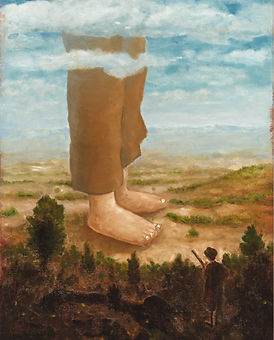
![Transformación Metafísica [also, The Great Transformation] (Telúricos #6) (2024), oil on linen, 63 cm x 46 cm](https://static.wixstatic.com/media/c596bd_eafbef19da964c7fb496bb63d07f1783~mv2.jpg/v1/fill/w_274,h_340,al_c,q_80,usm_0.66_1.00_0.01,enc_avif,quality_auto/DSC03058_edited.jpg)


SABRINA MERAYO NÚÑEZ
EXHIBITIONS

10/20/16 - 11/25/16
A passage to the abstraction of the senses.
Conformations: Sabrina Merayo Nuñez´s exhibition in Gachi Prieto Contemporary Art.
Knowledge is locked with them
not by representation
but by affective pollution
Felix Guattari, Chaosmosis
Sabrina Merayo Nuñez borrows from the stage and the laboratory the particular ways that her objects exhibit. We see the minimum required number of parts to establish a hypothesis of the human gesture that intersects matter. The pieces are strong enough to stand on their own and the imprint of work done on them appears as a single argument. Isolated and reunited, the pieces are distributed in the space surrounded by silence, this being the best appearance of meaning. The presentation of forces is replicated from the theatre stage (like in the encounter of the protagonist and the agonist in it or like in the projection of the actor's voice to his audience), the difference lying in that here the bodies are materials in a concrete state rather than figurative and what we see are brief scenes frozen in time: resistances of the material, mutations to which they were subjected, processes suspended halfway to becoming something else; ultimately tests and displacements. From the lab, not only we recognize the way in which the object is approached and analyzed in its parts, we can, above all, recognize that each piece is a sample obtained at the artist´s workshop between tools and books, between objects to disarm and works to be finished.
By using its own collection of materials from the world of furniture, Merayo Nuñez makes a type of inventory that associates the artistic gesture with a philosophical perspective in the particular context of the gallery´s white cube; she focuses on operations that were used to change the matter before the norm was the industrialization of the object. Here the artist acts as a collector and alchemist: she removes objects from their source of origin and inserts them into that space to appear seemingly neutral like the museum aesthetic that adds aesthetic value and an appropriate distance from the utilitarian world. In this territory of the poetic the viewer is invited to read each form with tactile eyes, to walk to the meeting of materials given in the pieces and to pay attention to the tensions, to that which gives and which vibrates in those abstract relations. These conformations can be read as haiku, for their brevity and for evoking an instant. Their reading is primarily a passage to the abstraction of the senses.
The artist displays a collection of works that account for the relationship between humans, ideas and the objects present in the dramas of our own history read through the furniture and the ornament. There is a universal force in the practice of Merayo Nuñez, applicable to the metaphor of the machine: the exposure of its parts, their relationships and the notion of their limits before the whole set that may appear opaque to the user; this to make visible what usually appears invisible. What is the syntax of an object? How many ways are there to combine and arrange a set of materials? What happens when those same materials, forced by the power of the work applied to that matter, are directed towards new states? These are some of the questions that might have guided the work done in Conformations. It is fair to say that there is research on how objects and materials are given different roles and meanings over time and different cultures until they reach our present; in this case, the artist dismantles and rearranges them to be able to find other powers in those relationships. Small powers, brief meeting instants that divert the natural course of our relationship with them and propose a way of being in the world differently or at least, more awaken, more alert.
Mariana Rodriguez Iglesias
Nuñez, Spring 2016
SABRINA MERAYO NÚÑEZ
BIO
Sabrina Merayo Núñez (Tierra del Fuego, Argentina, 1980)
Wood has become Sabrina Merayo Núñez's starting point when making sculptures and installations. She has been investigating different wood craft processes (cabinet making, carving, inlays) and the organic substances used for its conservation. Some years ago, she became interested in the biological processes of trees, focusing on how technology influences our relationship with nature.
Due to her interest in Bioart, she has been working with DNA extraction from different tree species and its comparison with the human genetic code. Additionally, in her artistic installations, she involves mixed media such as laboratories samples, notes, records, drawings and sculptures.
Merayo Núñez has studied Visual Arts at Universidad Nacional de las Artes and the Escuela Nacional de Bellas Artes Prilidiano Pueyrredón. Additionally, she studied Fine Arts at Universidad de Buenos Aires and Art Valuation at Universidad del Museo Social Argentino. In 2015, she was selected to participate in the annual program for artists Proyecto PAC of Galería Gachi Prieto
She featured her work in national and international exhibitions held in numerous institutions such as: Museo de Bellas Artes de Houston (Texas, United States); Euroamerica Gallery (New York, United States); Galleria Don Chisciotte (Rome, Italy); Galería Gachi Prieto (Buenos Aires, Argentina) and Perotti Galería (Buenos Aires, Argentina), among others.
Regarding awards and recognitions, she participated in the XX Fundación Klemm Visual Arts award (Buenos aires, Argentina, 2016); Itaú Cultural Visual Arts Award (Buenos Aires, Argentina, 2016); William Foundation Award (Buenos Aires, Argentina, 2015); UADE National Visual Arts Contest Buenos Aires, Argentina, 2015) and she also received a Honorary Mention in the Andreani Visual Arts award (Buenos Aires, Argentina 2015).
In 2019 she was selected to be part of the Artistas Latinex NYC Creative Capital Workshop, and, in 2018, she developed her project Humans as trees in the Coalesce Center for Biological Arts, University of Buffalo (New York, United States). In 2017, she participated in the Bioart Residency of the School of Fine Arts in New York, United States